In this guide
Food cost percentage is the share of your food sales that you spent on the ingredients used to make them. If you sell 1,000,000 FCFA of food and used 320,000 FCFA of ingredients, your food cost is 32%. Simple in principle, often wrong in practice, because people use purchases instead of usage, or mix drinks with food.
The formula
Food cost % = Cost of food used ÷ Food sales × 100
Cost of food used = Opening food inventory + Food purchases − Closing food inventory
All values at cost (what you paid), for the same period, and food only. Calculate drinks separately as pour cost.
Worked example (one month)
| FCFA | |
|---|---|
| Opening food inventory (1st of the month) | 1,200,000 |
| Food purchases during the month | 4,800,000 |
| Closing food inventory (last day) | 1,100,000 |
| Cost of food used | 4,900,000 |
| Food sales (from POS) | 14,500,000 |
| Food cost % | 33.8% |
Why not just use purchases? Because purchases ≠ usage. If you stocked up on rice at month end, purchases jump but you didn’t use more. Inventory counts fix that.
What’s a good food cost percentage?
Benchmarks vary by concept and country, but commonly cited targets are:
| Concept | Typical food cost target |
|---|---|
| Quick service / fast food | about 25–32% |
| Casual full-service | about 28–35% |
| Fine dining | often 30–38% (higher ingredient costs, higher prices) |
Look at prime cost too: food and drink cost plus labour. Many operators aim to keep prime cost at or below 60–65% of sales (Toast). A low food cost with very high labour cost isn’t a win.
Most importantly, compare yourself with yourself: this month vs last month, actual vs ideal.
Actual vs ideal food cost
Ideal (theoretical) food cost is what your food cost should be given what you sold:
Ideal food cost = Σ (portions sold × plate cost) ÷ food sales
If ideal is 30% and actual is 34%, four points of food sales are disappearing through waste, over-portioning, spoilage, unrecorded staff meals or theft. On 14.5 million FCFA of food sales, that’s 580,000 FCFA a month.
Plate cost: pricing each dish properly
Plate cost is the ingredient cost of one portion.
Example: grilled fish with plantain
| Ingredient | Quantity | Cost |
|---|---|---|
| Fish | 1 piece | 1,400 |
| Plantain | 2 fingers | 200 |
| Spices, oil, onions | — | 150 |
| Sauce | 1 portion | 100 |
| Plate cost | 1,850 FCFA |
At a target food cost of 33%, the menu price should be about 1,850 ÷ 0.33 ≈ 5,600 FCFA. If you sell it at 4,500, that dish runs at 41% food cost. It may still be worth keeping, but you should know.
Menu engineering in 10 minutes
Classify each dish by popularity (units sold) and profitability (price − plate cost):
| High profit | Low profit | |
|---|---|---|
| High popularity | Stars: keep and feature | Plowhorses: review price or portion |
| Low popularity | Puzzles: promote, reposition | Dogs: remove or rework |
Your POS sales by item gives you popularity. Your plate costs give you profitability.
10 ways to lower food cost without cutting quality
- Standardise recipes and portions. Use scoops, scales and photos at the pass.
- Record all waste so you can see what’s thrown away and why.
- Set par levels and order to them, to avoid spoilage from over-buying.
- Receive carefully: weigh, count, check quality, refuse short deliveries.
- FIFO storage with date labels.
- Cross-utilise ingredients across dishes to reduce waste.
- Reprice plowhorses slightly, or adjust their portion.
- Renegotiate with suppliers using your purchase history.
- Control staff meals. Ring them up at a staff price, or record them.
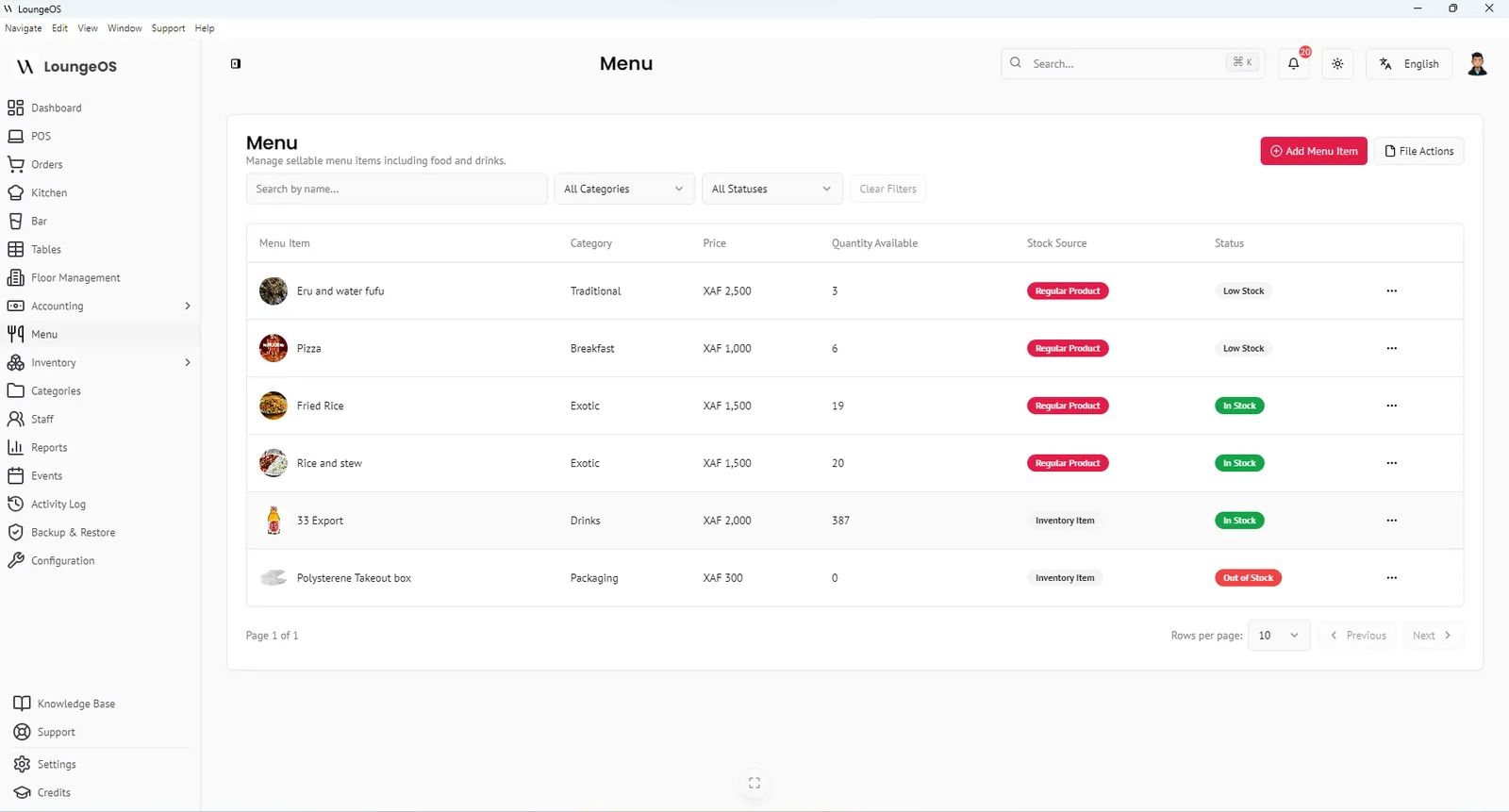
- Stop selling what you don’t have. In LoungeOS, dishes at zero available quantity are greyed out on the POS.
Where the numbers come from in LoungeOS
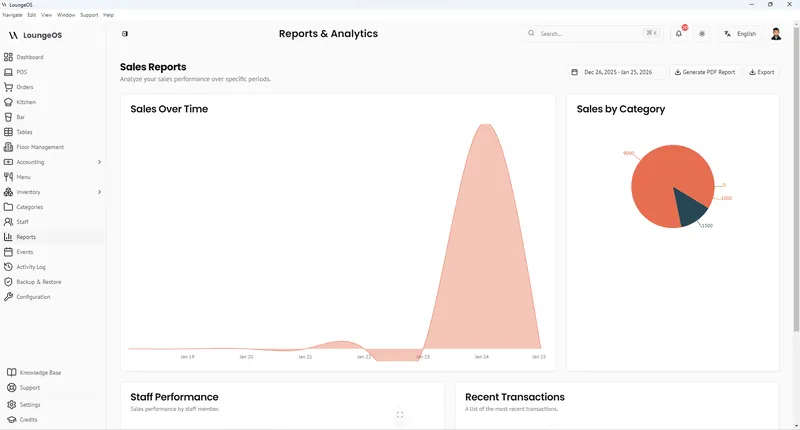
- Food sales: sales by category in reports, with food categories marked as such
- Purchases: stock-in entries with unit costs in inventory
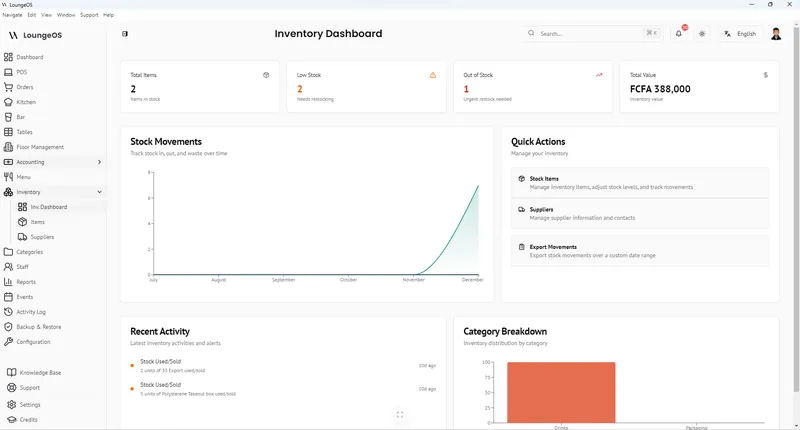
- Opening and closing inventory: the inventory dashboard’s total stock value
- Waste: stock-out entries for damage, waste and loss
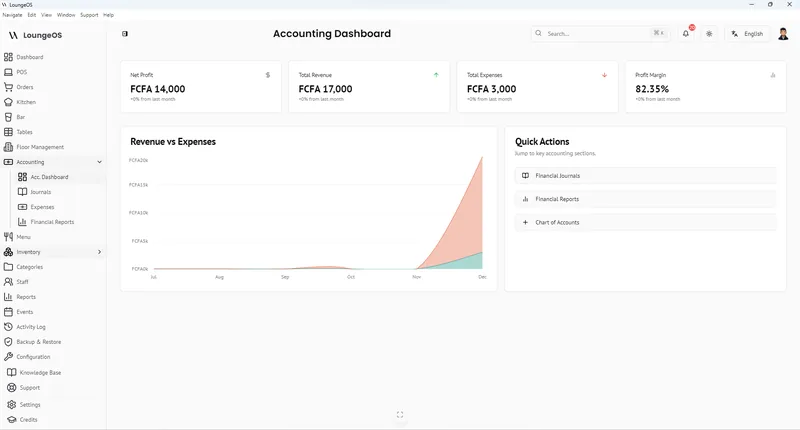
- P&L: the accounting module after syncing the month
Run your next service on LoungeOS
Install LoungeOS on a Windows computer, connect your tablets and phones over Wi-Fi, and run real service for 30 days. Free, no credit card.
Frequently asked questions
How do you calculate food cost percentage?
Food cost % = (opening food inventory + food purchases − closing food inventory) ÷ food sales × 100, using cost values for the same period.
What is a good food cost percentage for a restaurant?
Commonly cited targets are about 28–35% for full-service restaurants and lower for quick service. Compare your actual food cost with your ideal food cost and your own history.
What is the difference between food cost and plate cost?
Food cost percentage measures the whole kitchen over a period. Plate cost is the ingredient cost of one portion of one dish, used to set its menu price.
What is prime cost?
Prime cost is the cost of goods sold (food and drink) plus total labour cost. Many restaurants aim to keep it at or below about 60–65% of sales.