In this guide
Many restaurants run for years knowing only “how much came in today”. That’s sales, not profit. Restaurants can be busy and still lose money, especially with full-service net margins often reported in the low single digits (around 3–6%). This guide covers the accounting every owner should understand, in plain language.
The restaurant P&L (income statement)
The profit and loss statement covers a period, usually a month, and answers: did we make money?
| Line | Example (FCFA) | % of sales |
|---|---|---|
| Food sales | 14,500,000 | |
| Beverage sales | 9,500,000 | |
| Total sales | 24,000,000 | 100% |
| Cost of food sold | 4,900,000 | |
| Cost of beverages sold | 2,400,000 | |
| Cost of goods sold (COGS) | 7,300,000 | 30.4% |
| Gross profit | 16,700,000 | 69.6% |
| Salaries and wages | 6,200,000 | 25.8% |
| Rent | 1,800,000 | 7.5% |
| Utilities (power, water, fuel) | 1,400,000 | 5.8% |
| Marketing | 400,000 | 1.7% |
| Repairs and maintenance | 350,000 | 1.5% |
| Waste and losses | 300,000 | 1.3% |
| Other operating expenses | 900,000 | 3.8% |
| Operating profit | 5,350,000 | 22.3% |
| Depreciation, interest, tax | 3,600,000 | |
| Net profit | 1,750,000 | 7.3% |
The key ratio: prime cost
Prime cost = COGS + total labour
Here: 7,300,000 + 6,200,000 = 13,500,000 = 56% of sales. Many operators aim for 60–65% or below, so this example is healthy.
The balance sheet
The balance sheet is a snapshot on one date: what the business owns (assets), what it owes (liabilities) and what belongs to the owners (equity). It always balances:
Assets = Liabilities + Equity
Typical restaurant entries:
- Assets: cash in the till and safe, bank accounts, mobile money wallets, inventory, equipment, deposits
- Liabilities: supplier invoices not yet paid, taxes owed, salaries owed, loans
- Equity: capital invested by the owners plus profits kept in the business
The balance sheet tells you if you can pay your suppliers next month, and whether profits are piling up as stock instead of cash.
The cash-flow statement
Profit isn’t cash. You can be profitable on paper and still short of cash, because you bought a lot of stock, repaid a loan or bought a new freezer. The cash-flow statement splits cash movements into:
- Operating: cash from sales minus cash paid for stock, wages and expenses
- Investing: equipment and renovations
- Financing: loans, repayments, owner contributions and withdrawals
Double-entry bookkeeping in two minutes
Every transaction affects at least two accounts, with debits = credits:
| Transaction | Debit | Credit |
|---|---|---|
| Sale paid in cash, 10,000 | Cash 10,000 | Sales revenue 10,000 |
| Sale paid by MoMo, 8,000 | MoMo wallet 8,000 | Sales revenue 8,000 |
| Stock delivered on credit, 150,000 | Inventory 150,000 | Supplier payable 150,000 |
| Supplier paid by bank, 150,000 | Supplier payable 150,000 | Bank 150,000 |
| Broken bottles written off, 6,000 | Waste & loss expense 6,000 | Inventory 6,000 |
This structure catches errors, because unbalanced entries are impossible, and it is what lets software produce a balance sheet automatically.
A simple chart of accounts for a restaurant
| Class | Accounts |
|---|---|
| Assets | Cash on hand, bank, mobile money wallets (one per operator), inventory, equipment |
| Liabilities | Supplier payables, taxes owed, salaries owed, loans |
| Equity | Owner’s capital, retained earnings |
| Revenue | Food sales, beverage sales, event services |
| Expenses | Cost of goods sold, wages, rent, utilities, marketing, repairs, waste & loss |
In OHADA countries (Cameroon, Côte d’Ivoire, Senegal and others), statutory accounts follow SYSCOHADA. Your accountant maps your management accounts to the SYSCOHADA chart for official filings.
The monthly close: a one-day routine
- Sync sales from the POS for the month.
- Record all expenses: rent, salaries, utilities, repairs, marketing.
- Enter supplier invoices and payments.
- Count inventory and value it at cost.
- Reconcile cash, bank and mobile money against statements.
- Read the P&L: compare COGS %, labour %, prime cost % and net profit % with last month.
- Read the balance sheet and cash flow: can you pay next month’s bills?
How LoungeOS handles this
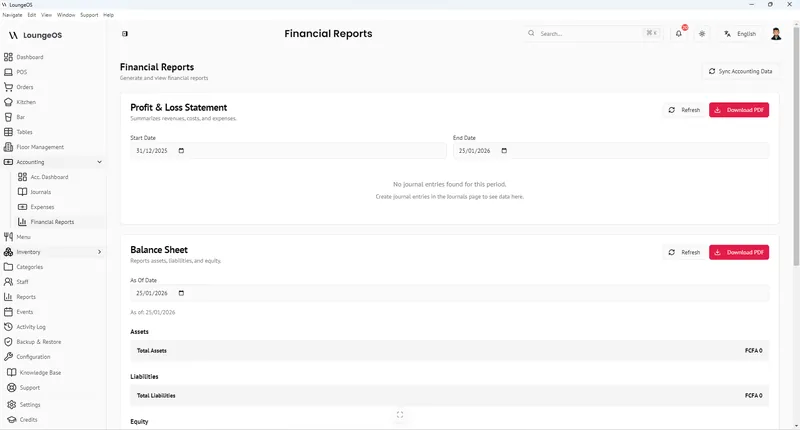
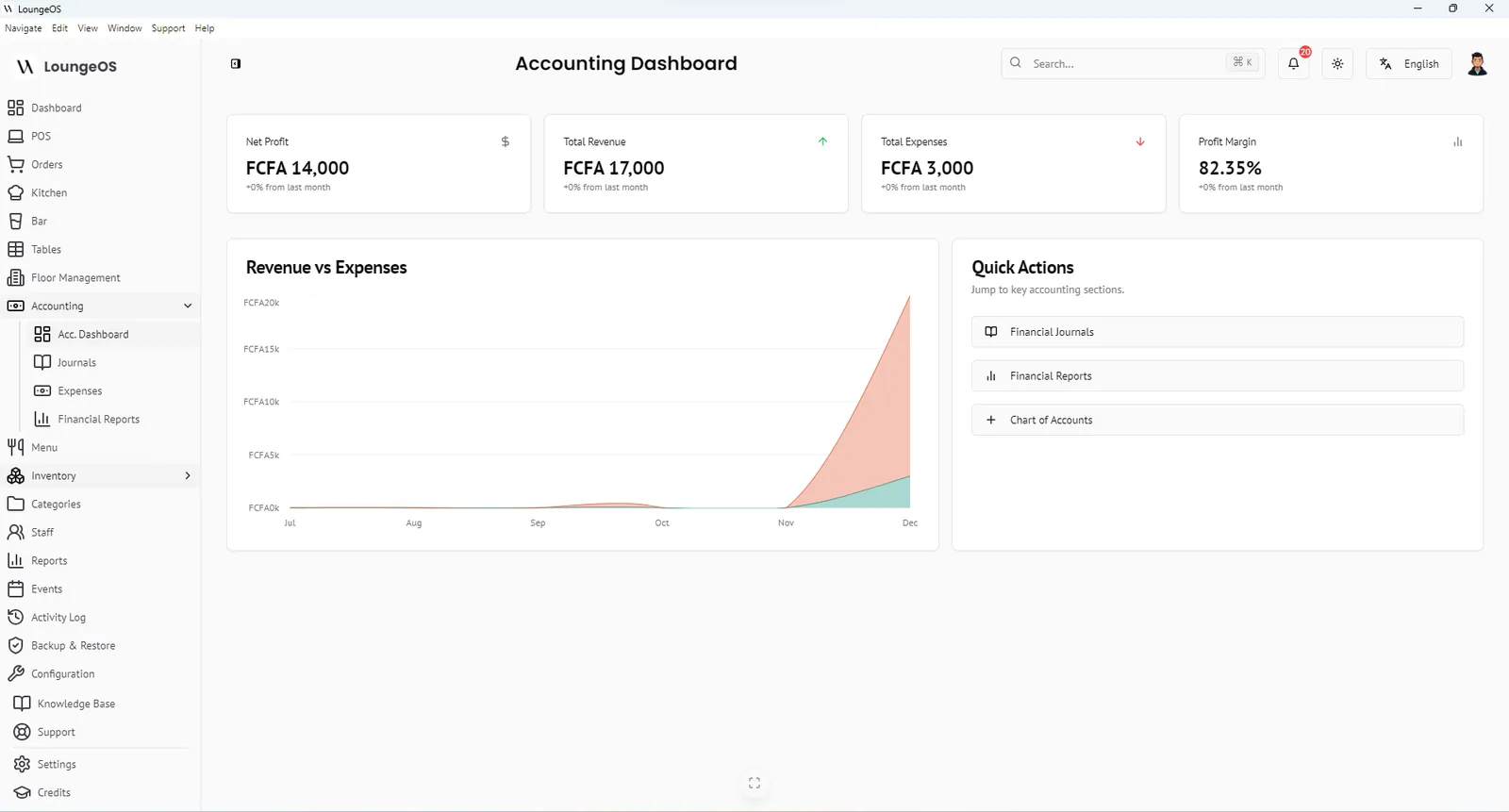
LoungeOS keeps a double-entry ledger with a five-class chart of accounts. Clicking Sync Accounting Data for a date range turns paid POS orders and stock purchases into balanced journal entries. Expenses are recorded in the expense screen, and stock losses flow in as expenses. You get the income statement, balance sheet and cash-flow statement for any period, exportable to PDF or CSV for your accountant.
Run your next service on LoungeOS
Install LoungeOS on a Windows computer, connect your tablets and phones over Wi-Fi, and run real service for 30 days. Free, no credit card.
Frequently asked questions
What financial statements does a restaurant need?
An income statement (P&L), a balance sheet and a cash-flow statement. Together they show profit, financial position and cash movements.
What is COGS in a restaurant?
Cost of goods sold: the cost of the food and drinks used to make what you sold in the period, calculated as opening inventory + purchases − closing inventory.
What is a good net profit margin for a restaurant?
Full-service restaurants often report net margins of about 3–6%, and quick-service restaurants somewhat higher. Bars with strong beverage sales can do better. Compare with your own history and track prime cost.
Do I still need an accountant if my POS does accounting?
Yes, for tax filings, statutory accounts (for example SYSCOHADA in OHADA countries) and advice. A POS with accounting gives your accountant accurate, balanced data instead of a box of receipts.